UML for Systems Engineering: Watching the Wheels, Second Edition

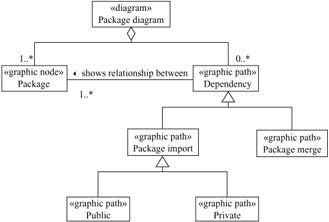
Package diagrams are new to UML 2.0, however, there is nothing new at all about the contents of a package diagram. Package diagrams, as the name implies, simply identify and relate together packages. The concept of the package is exactly the same as when used on other diagrams - each package shows a collection of diagram elements and implies some sort of ownership. The syntax for the package diagram is very simple and can be seen in Figure 5.28.
The diagram in Figure 5.28 shows the partial meta-model for the package diagram. It can be seen that there are two main elements in the diagram - the 'Package' that happens to be a graphical node and the 'Dependency' that happens to be a graphical path. There are two main types of 'Dependency' defined -' Package import' and 'Package merge'. The 'Package import' also has two types that are 'Public' and 'Private'.
The graphical notation for the package diagram is shown here and, as is quite clear, this is identical to the graphical notation in UML 1.x.
The diagram in Figure 5.29 shows that there are really only two symbols on the diagram. The graphical node is the same as the original package symbol - the rectangle with a smaller tag rectangle on the top left-hand edge. This is similar to the folder icon that can be seen in Windows systems and, indeed, has a very similar conceptual meaning. The...