UML for Systems Engineering: Watching the Wheels, Second Edition

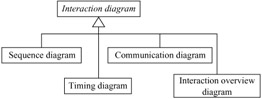
This section takes a bit of a departure from the other sections in this chapter, as four diagrams are being discussed rather than one. This is because an interaction diagram can be illustrated using four different types of diagrams: communication diagrams, sequence diagrams, timing diagrams and interaction overview diagrams. All diagrams show the same information, but from slightly different viewpoints. This relationship can be seen in the simple meta-model shown in Figure 5.40.
Each of the four types of diagrams shows the same information - how a collaboration behaves. The main aim of any interaction diagram is to show a particular example of operation of a system, in the same way as movie makers may draw up a storyboard. A storyboard shows the sequence of events in a film before it is made. Such storyboards in the UML are known as 'scenarios'. Scenarios highlight pertinent aspects of a particular situation and ignore all others. Each of these aspects is represented as an element known as a 'Life line'. This is rather confusing as UML 1.x had an element known as a 'Life line' with a slightly different use. Therefore, to make the difference explicit, each will be discussed below:
A 'Life line' in UML 1.x represents time going down a page underneath an object, as seen in sequence diagrams.
A 'Life line' in UML 2.0 represents an individual participant in an interaction, that will refer to an...