UML for Systems Engineering: Watching the Wheels, Second Edition

5.8: Activity Diagrams

5.8 Activity Diagrams

5.8.1 Overview

This section looks at another behavioural model of a system: the activity diagram. Activity diagrams, generally, allow very low-level modelling to be performed compared to the behavioural models seen so far. Where interaction diagrams show the behaviour between objects, and state machine diagrams show the behaviour within objects, activity diagrams may be used to model the behaviour within an operation, which is about as low as it is possible to go.

The other main use for activity diagrams and certainly the most commonly seen usage of activity diagrams in other texts is to model 'workflows'. This will be discussed in some detail later in this chapter as the level of abstraction of a workflow can vary.

Activity diagrams are actually special types of state machine diagrams and, as will be seen, the constructs are very similar between the two types of diagram. Activity diagrams are also similar to traditional flow charts (from which they were derived), which is often a cause for comment or even criticism of the UML.

5.8.2 Diagram Elements

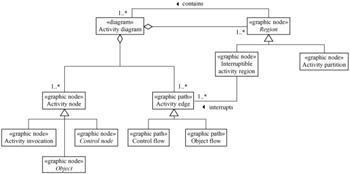
Activity diagrams have changed considerably in UML 2.0 and, indeed, some of the fundamental terms used in UML 1.x have now been replaced. Perhaps the largest difference is the basic type of graphical node - in UML 1.x there were states (action states and activity states) whereas in UML 2.0 these have been replaced by activity invocations. Figure 5.58 shows this and all the other main elements in an activity diagram.


Figure 5.58:

UNLIMITED FREE
ACCESS
TO THE WORLD'S BEST IDEAS

SUBMIT
Already a GlobalSpec user? Log in.

This is embarrasing...

An error occurred while processing the form. Please try again in a few minutes.

Customize Your GlobalSpec Experience

Category: Computer-Aided Design (CAD) Services
Finish!
Privacy Policy

This is embarrasing...

An error occurred while processing the form. Please try again in a few minutes.