UML for Systems Engineering: Watching the Wheels, Second Edition

Oh, behave
Austin Powers
Chapter 3 introduced structural modelling, one of the two basic aspects of modelling using the Unified Modelling Language (UML), by choosing one type of structural diagram and using it to explain basic principles that may then be applied to any sort of structural modelling. This chapter takes the same approach, but with behavioural modelling.
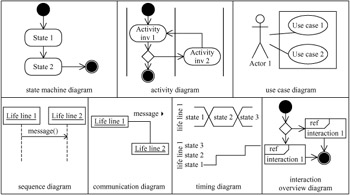
Behavioural models may be realised using seven types of UML diagram, which are: use case diagrams, state machine diagrams, activity diagrams and interaction diagrams, of which there are four types - communication, timing, interaction overview and sequence diagrams, as shown in Figure 4.1.
It is stated in Chapter 3 that structural modelling defines the 'what' of a system: what it looks like, what it does and what the relationships are. If structural modelling tells us 'what', then behavioural modelling tells us 'how'. This 'how' is described by modelling interactions within a system. These interactions may be modelled at many levels of abstraction; different types of behavioural diagrams allow the system to be modelled at different levels of abstraction. These levels of abstraction may be categorised as follows:
Interactions may be modelled between objects or between subsystems. Such models are realised using the four types of interaction diagram: communication, timing, interaction overview or sequence diagram.
Interactions may also be modelled at a slightly lower level of abstraction by considering the interactions within a class or its associated objects.