Earth Anchors

2.2: EARLY THEORIES

2.2 EARLY THEORIES

Soil Cone Method

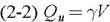
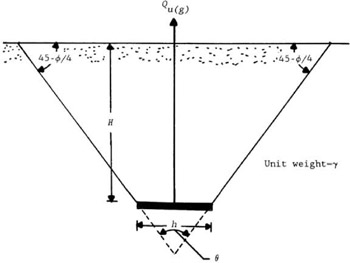
Some of the early theories to determine the net ultimate uplift capacity Q u were restricted to shallow circular plate anchors. Mors (1959) proposed that the failure surface in soil at ultimate load may be approximated as a truncated cone having an apex angle of ? = 90 + ?/2 as shown in Figure 2-3. The net ultimate uplift capacity may be assumed to be equal to the weight of the soil located inside the failure surface. Thus


Figure 2-3: Mors' theory soil cone method ( Note: ? = 90 + ?/2; h = diameter of anchor plate)

where V

= volume of soil in the truncated cone

?

= unit weight of soil

However


Or


It needs to be pointed out that the shearing resistance developed along the failure surface has been neglected in Equation (2-2).

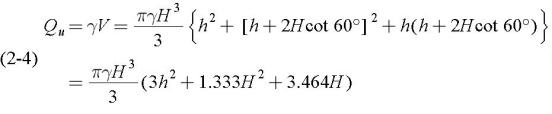
A similar theory was also proposed by Downs and Chieurzzi (1966),who suggested that the apex angle ? be taken as being equal to 60 as shown in Figure 2-4. For this case


Figure 2-4: Downs and Chieurzzi's theory soil cone method ( Note: h = diameter of anchor plate)

Friction Cylinder Method

In many cases in the past, the friction cylinder method was used to estimate the uplift capacity of shallow circular anchor plates. In this type of calculation, the friction surface in the soil was assumed to be cylindrical as shown in Figure 2-5a. For cohesionless soils,...

UNLIMITED FREE
ACCESS
TO THE WORLD'S BEST IDEAS

SUBMIT
Already a GlobalSpec user? Log in.

This is embarrasing...

An error occurred while processing the form. Please try again in a few minutes.

Customize Your GlobalSpec Experience

Category: Electric Brakes
Finish!
Privacy Policy

This is embarrasing...

An error occurred while processing the form. Please try again in a few minutes.