Earth Anchors

Theoretical and experimental research results presently available for determination of the net ultimate uplift capacity of plate anchor embedded in saturated clay soil are rather limited. In this section the results of the existing studies will be reviewed.
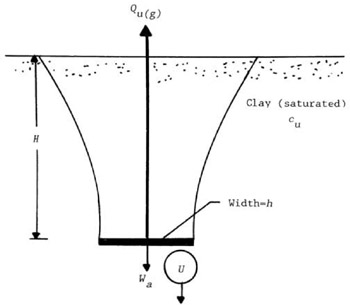
Figure 2-46 shows a plate anchor embedded in a saturated clay at a depth H below the ground surface. The width of the anchor plate is equal to h and the undrained cohesion of the clay is c u In soft saturated clay, when the anchor is subjected to an uplift force, the soil located above the anchor will be compressed and, at the same time, the soil below the anchor will be relieved of some stress. This will, in turn, result in an increase of the pore water pressure above the anchor accompanied by a decrease of pore water pressure below the anchor. The difference will result in a suction force. This suction force will increase the short-term uplift capacity of the anchor. Thus the uplift capacity can be given by the expression
| where Q u( g) and Q u | = gross and net ultimate uplift capacity, respectively |
| W a | = effective weight of the anchor |
| U | = suction force below the anchor |
Very little is known at the present time about the magnitude of the suction force and its variation with depth and type of clay soil.