Earth Anchors

More recently, several theoretical and semi-empirical methods were developed to predict the ultimate uplifting load of strip, circular and rectangular anchors embedded in sand. Some of these theories are briefly described in this section.
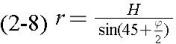
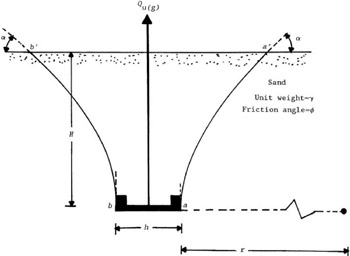
Based on several model and field test results in dense soil, Balla (1961) established that, for shallow circular anchors, the failure surface in soil will be as shown in Figure 2-6. Note from the figure that aa ? and bb ? are arcs of a circle. The angle ? is equal to 45 ?/2. The radius of the circle, of which aa ? and bb ? are arcs, is equal to
The net ultimate uplift capacity of the anchor is the sum of two components: (a) weight of the soil in the failure zone and (b) the shearing resistance developed along the failure surface. Thus
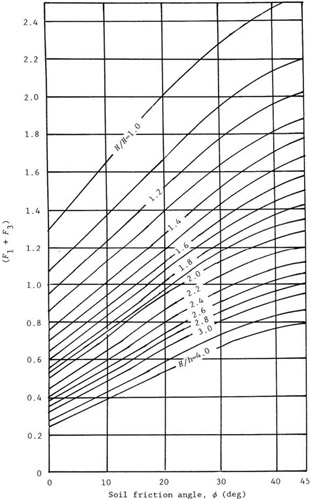
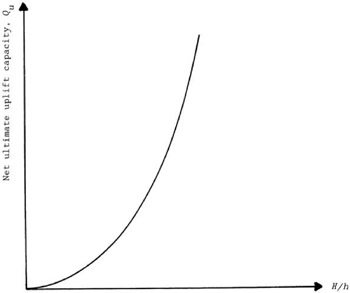
The sums of the functions F 1( ?, H/h) and F 3 ( ?, H/h> developed by Balla (1961) are plotted in Figure 2-7 for various values of the soil friction angle ? and embedment ratio H/h. The general nature of the plot of Q u versus H/h will be like that in Figure 2-8.