Earth Anchors

In order to determine the allowable net ultimate uplift capacity of plate anchors, two different procedures can be adopted:
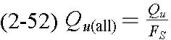
Use of a tentative factor of safety, F S, based on the uncertainties of determination of the soil shear strength parameters and other associated factors. For this type of analysis
Use of a load-displacement relationship. In this method, the allowable net ultimate uplift capacity is calculated which corresponds to a predetermined allowable vertical displacement of the anchor.
Das and Puri (1989) investigated the load-displacement relationship of shallow horizontal square and rectangular plate anchors embedded in medium and dense sand. For these laboratory model tests, the width of the anchor plate ( h) was kept at 50.8 mm. The length-to-width ratios of the anchors ( B/h) were varied from one to three, and the H/h ratios were varied from one to five. Based on their laboratory observations, the net load Q versus vertical displacement ? plots can be of two types, as shown in Figure 2-30. In Type I, the net load increases with displacement up to a maximum value at which sudden pullout occurs. The maximum load in this case is the net ultimate uplift capacity Q u In Type II, the net load increases with the vertical displacement fairly rapidly up to a certain point, beyond which the load-displacement relationship becomes practically linear. For this case, the net ultimate uplift capacity is defined as the point...