Earth Anchors

Chapter 3: Vertical Plate Anchors

3.1 INTRODUCTION

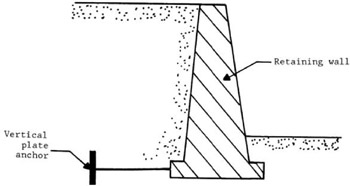
The use of vertical anchor plates to resist horizontal loading in the construction of sheet pile walls has been discussed in Chapter 1 (Figure 1-4). Inadequate design of anchors has been the cause of failure of many sheet pile walls. Sheet pile walls are flexible structures and, due to the outward bulging of these walls, the lateral earth pressure produced is quite different than that calculated for rigid structures using the classical Rankine or Coulomb earth pressure theories. In conducting laboratory measurements, Rowe (1952) showed that the bending moment to which an anchored sheet pile wall is subjected can be substantially reduced when the anchor movement is less than about 0.1% of the height of the wall. The movement of 0.1% of the anchor includes the elongation of the tie rod connecting the vertical plate anchors and the wall. Hence it is Important to make proper estimation of the ultimate and allowable holding capacities of plate anchors and also the corresponding displacements. Vertical plate anchors can also be used at pressure pipeline bends, at the base of retaining walls to resist sliding (Figure 3-1), and also where it is necessary to control thermal stresses.


Figure 3-1: Vertical plate anchor at the base of a retaining wall to resist sliding

Figure 3-2 shows the geometric parameters of a vertical anchor plate. The height and width of the anchor plate are h and B, respectively. The depth of embedment of the anchor plate is H (that is,...

UNLIMITED FREE
ACCESS
TO THE WORLD'S BEST IDEAS

SUBMIT
Already a GlobalSpec user? Log in.

This is embarrasing...

An error occurred while processing the form. Please try again in a few minutes.

Customize Your GlobalSpec Experience

Category: Retaining Walls
Finish!
Privacy Policy

This is embarrasing...

An error occurred while processing the form. Please try again in a few minutes.