Embedded Systems Building Blocks, Second Edition

Chapter 11: Asynchronous Serial Communications

Overview

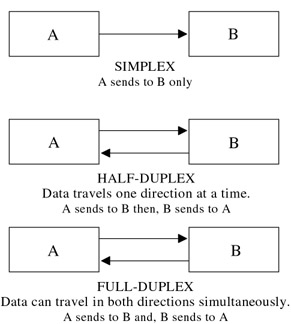
The world of data communications is very complex. A single book (let alone a chapter) cannot cover everything. Data communication is concerned specifically with the issues that must be considered when communicating data between two devices (generally computers). When computing elements are distant from one another, in most cases data is transmitted serially. Because data in a computer is handled in parallel (8 bits or more), it is necessary to convert this information from parallel to serial (when sending) and from serial to parallel (when receiving). There are basically three modes of communication, as shown in Figure 11.1:

  1. Simplex: Data travels in one direction (from A to B). An example of a simplex link would be scoreboards such as those used in hockey, basketball, or other sports. The information is entered at a console by the score/timekeeper and sent serially to large displays that everybody can see.

  2. Half-duplex: Data travels in one direction (from A to B) and then the other direction (from B to A) but not at the same time. The RS-485 interface (discussion starts on page ) is half-duplex.

  3. Full-duplex: Data can travel in both directions at the same time.


Figure 11.1: Communication modes.

In this chapter, I will briefly discuss asynchronous communications, the RS-232C standard, the RS-485 standard, the serial ports on a PC, and how data is sent and received on an asynchronous communication port. This chapter is not concerned with what is actually sent and received. In other...

UNLIMITED FREE
ACCESS
TO THE WORLD'S BEST IDEAS

SUBMIT
Already a GlobalSpec user? Log in.

This is embarrasing...

An error occurred while processing the form. Please try again in a few minutes.

Customize Your GlobalSpec Experience

Category: Serial Communications Products
Finish!
Privacy Policy

This is embarrasing...

An error occurred while processing the form. Please try again in a few minutes.