Embedded Systems Building Blocks, Second Edition

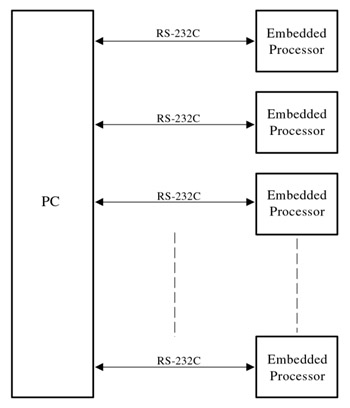
The RS-232C standard requires that a direct connection be made between two devices. This is known as a point-to-point interface. If, for example, you need to communicate with many embedded microprocessors, you would need to dedicate an RS-232C port for each embedded processor, as shown in Figure 11.9 . This situation can become expensive if the embedded processors are located far from the PC. Also, RS-232C is fairly susceptible to noise because of its common ground arrangement.
The RS-485 interface has been created to allow multiple (up to 32) processors to communicate with each other on a common line. RS-485 is sometimes called a party-line or a multi-drop interface and is shown in Figure 11.10. The RS-485 interface uses differential line driver/receiver chips (such as the Texas Instruments SN75176A Differential Bus Transceiver) and only requires a single twisted pair of wires. Communication on an RS-485 interface is, however, half-duplex. Each communicating element on an RS-485 interface is called a node and communication generally follows a MASTER/SLAVE protocol (but doesn't have to). One of the nodes is called the MASTER while all other nodes are called SLAVEs. In a MASTER/SLAVE arrangement, all communication occurs between the MASTER and a SLAVE (not between SLAVEs). Each node on an RS-485 is assigned a unique node I.D. number. Node #0 is generally assigned to the MASTER. The MASTER selectively communicates with one of...