Embedded Systems Building Blocks, Second Edition

11.01: RS-232C

11.01 RS-232C

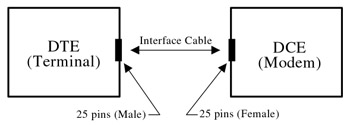
Dating all the way back to 1969, the RS-232C standard is probably the most widely used communication interface in the world. RS-232C was defined by the Electronic Industries Association (EIA) and is formally known as: "Interface between data terminal equipment and data communication equipment employing serial binary data interchange." As shown in Figure 11.4, the RS-232C standard is a hardware protocol used to interface between two devices: one is called the Data Terminal Equipment (DTE) and the other, the Data Communication Equipment (DCE). The RS-232C standard defines:


Figure 11.4: RS-232C interface.
  1. The mechanical aspects of the interface.

  2. The characteristics of the electrical signals.

  3. The functional aspects of the interchange.

The RS-232C standard says that there should be two 25-pin connectors: the male connector is used on the DTE while the female connector is used on the DCE. The actual type of connector is not defined by the standard. The industry has, however, standardized on 25 pins D-shell type connectors.

Electrically speaking, the RS-232C standard specifies that:

  • the load capacitance on a driver is not to exceed 2500 picofarads (pF),

  • the load resistance on a driver must be between 3000 and 7000 ohms,

  • the data signaling rate (or baud rate) must be below 20,000 bits per second (bps) under the specified load,

  • the maximum levels on the RS-232C lines are not to exceed 15 volts (with respect to signal ground),

  • drivers must be able to produce between +5 and +15 volts (logic 1)...

UNLIMITED FREE
ACCESS
TO THE WORLD'S BEST IDEAS

SUBMIT
Already a GlobalSpec user? Log in.

This is embarrasing...

An error occurred while processing the form. Please try again in a few minutes.

Customize Your GlobalSpec Experience

Category: Multipurpose Computer Boards
Finish!
Privacy Policy

This is embarrasing...

An error occurred while processing the form. Please try again in a few minutes.