Location and Personalisation: Delivering Online and Mobility Services

This book takes a look at two application technologies location and personalization and presents an understanding of the technical and business impact of these technologies.
 TABLE OF CONTENTS
 S Appleby
The ubiquity of the World Wide Web (WWW) has given us the means to access information from all around the world if only we could understand the language in which it is written!
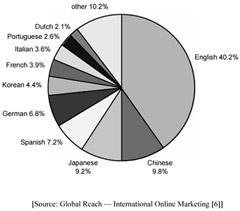
Currently, non-English-speaking World Wide Web users outnumber English-speaking users, with the number of non-English users growing at a far greater rate (see Fig 9.1). Particularly fast growth is seen in China, Brazil and Korea. Providers of Internet-based services will have to become multilingual and multicultural if they are to capitalise on this huge increase in potential market.
Internet portal providers were among the first to recognise the value that can be added to their services by providing facilities, such as automatic translation, to help users cope with information in other languages.
For example, AltaVista [1] allows automatic translation of Web pages using the Systran translation system [2, 3], and Yahoo [4] allows translation using the Logos translation system [5].
Making an application or service work in different languages may involve much more than just translating some of the text. In many cases, applications would benefit from being ported to other locales, but the cost is prohibitive because the system was designed originally for monolingual use, and it is now too expensive to re-engineer it. For example, mistaken choice of character encoding scheme at an early stage could make a significant difference to the cost of porting to other languages.
The aim...