Network Tutorial, Fifth Edition
This text is written for those trying to get up to speed or stay current with the complex challenges of designing, constructing, maintaining, upgrading, and managing the network infrastructure.
 TABLE OF CONTENTS
 Understanding the topology of LAN technologies can tell you a lot about your alternatives when installing or expanding a LAN. At its basic level, the topology of a network refers to the way in which all of its pieces have been connected. That is, it refers to the layout of the computers, printers, and other equipment hooked to the network in your building.
Because cable connects these scattered computing resources together into a network, your network's topology is also a function of the way in which the cabling is organized, whether it is arrayed in a bus, ring, or star, which are the three basic physical topologies available to LAN designers (see Figure 1). Although recent technological advances have blurred the distinctions between the physical and logical arrangements, the topology you select (or are forced to select) may also dictate the media-access control method (that is, Ethernet or Token Ring) under which your network will operate.
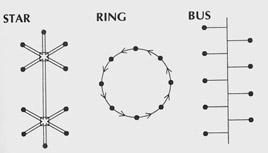
A network's logical layout may differ from its physical layout. The logical topology defines the electrical path; the physical path defines how the cables, concentrators, and nodes are arranged. For example, Ethernet must be a logical bus network; however, it can be physically configured as a bus or star. Token Ring is a logical...