Network Tutorial, Fifth Edition
This text is written for those trying to get up to speed or stay current with the complex challenges of designing, constructing, maintaining, upgrading, and managing the network infrastructure.
 TABLE OF CONTENTS
 It's been said time and again that Internet commerce won't be viable until tighter security measures are in place and consumers have confidence in them. But on a more basic level, securing computer files and e-mail is of much more concern to users on an everyday basis. After all, if you lose your laptop, your competition can potentially access the sensitive information you were carrying. Also, transferring files back and forth over the Internet or even through proprietary mail systems can present risks if the information is intercepted. To foil the plans of anyone trying to usurp electronic files, many have turned to cryptography, which encrypts and decrypts information such that it's useless to everyone except authorized users.
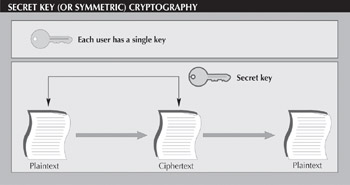
Traditional cryptosystems are based on the secret key, or symmetric, model (see Figure 1). In this system, each user has his or her own secret key, which is used for both encryption in which plaintext is converted to ciphertext and decryption in which the process is reversed.
An example of a secret key cryptosystem is the data encryption standard (DES), which was originally developed by IBM and endorsed by the U.S. government in 1977. DES uses a 56-bit key and has a 64-bit block...