Maximizing Machinery Uptime

Chapter 5: Is there a Universal Approach to Predicting Machinery Uptime?

Overview

In the preceding chapter we showed the usefulness of hazard functions in estimating machinery reliability. Frequently, it is not possible to arrive at an appropriate distribution function due to a lack of specific data and the need for complicated calculations. In many cases, and especially when comparing competing solutions to a technical problem (i.e., relative reliability), a constant failure rate for machinery components may be assumed and judiciously applied.

A constant failure rate assumption does not deviate too much from the real world for at least two reasons. First, different distribution functions for a variety of components when combined produce a random failure pattern. Second, repair at failure tends to produce a constant failure rate when the population is large. This has been demonstrated in the literature [1].

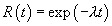
With a constant failure rate the reliability of components or systems follows the exponential distribution:

(5.1)

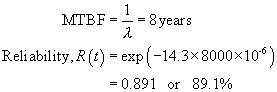
We have already seen that the reciprocal of failure rate is called Mean Time Between Failure (MTBF), or , the mean of the distribution. For example, small electric motors have typical failure rates of ? = 14.3 l0 -6/h. What is the MTBF of the motor and what is its reliability for a 8000-h operating period?


We assume that these motors cannot be repaired and have to be scrapped when they fail. We would like to determine the operating time after which these motors have to be exchanged to assure a survival probability of R( t r)...

UNLIMITED FREE
ACCESS
TO THE WORLD'S BEST IDEAS

SUBMIT
Already a GlobalSpec user? Log in.

This is embarrasing...

An error occurred while processing the form. Please try again in a few minutes.

Customize Your GlobalSpec Experience

Category: Reliability Software
Finish!
Privacy Policy

This is embarrasing...

An error occurred while processing the form. Please try again in a few minutes.