Microwave Measurements, 3rd edition

Chapter 5: Attenuation Measurement

Alan Coster

5.1 Introduction

Accurate attenuation measurement is an important part of characterising radio frequency (RF) or microwave circuits and devices. For example, attenuation measurement of the component parts of a radar system will enable a designer to calculate the power delivered to the antenna from the transmitter, the noise figure of the receiver and hence the fidelity or bit error rate of the system. A precision power measurement system, such as the calorimeter described by Oldfield [1], requires the transmission line preceding the measurement element to be characterised to determine the effective efficiency of the system. The thermal electrical noise standard described by Sinclair [2] requires accurate attenuation measurement of the transition or thermal block between the hot termination and the ambient temperature output connector to determine its excess noise ratio.

5.2 Basic Principles

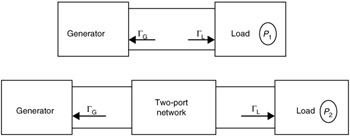
With reference to Figure 5.1, when a generator with a reflection coefficient ? G is connected directly to a load of reflection coefficient ? L, let the power dissipated in the load be denoted by P 1. Now if a two-port network is connected between the same generator and load, let the power dissipated in the load be reduced to P 2.


Figure 5.1: Insertion loss

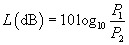
Insertion loss in decibels of this two-port network is defined as follows:

(5.1)

Attenuation is defined as the insertion loss where the reflection coefficients ? G and ? L = 0.

Note that insertion loss depends on the value of ? G

UNLIMITED FREE
ACCESS
TO THE WORLD'S BEST IDEAS

SUBMIT
Already a GlobalSpec user? Log in.

This is embarrasing...

An error occurred while processing the form. Please try again in a few minutes.

Customize Your GlobalSpec Experience

Category: RF Isolators and RF Circulators
Finish!
Privacy Policy

This is embarrasing...

An error occurred while processing the form. Please try again in a few minutes.