Microwave Measurements, 3rd edition

18.2: Dielectrics - Basic Parameters

18.2 Dielectrics - Basic Parameters

Introductory theoretical treatments on dielectrics can be found in most standard textbooks on electromagnetism and in books on dielectrics (e.g. see [1, 5, 7 12]).

The quantity with which we are most concerned here is the relative permittivity, ?*. This can be converted to the absolute permittivity if we multiply it by the permittivity of free-space, ? 0 = 8.8542 10 12 F m -1. Note that absolute permittivities in the SI system have units of farads per metre, whereas relative permittivities are dimensionless quantities. In the practical world we are usually concerned with relative permittivities. As it is a complex quantity, ?* has two components:

(18.1)

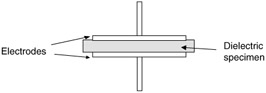
where . If we assume that our dielectric material is placed between plane-parallel electrodes to form a capacitor, as in Figure 18.1, ?', the real part of the permittivity, characterises the capacitative part of the admittance, Y, of the capacitor and ?" characterises the conductive or lossy part of the admittance. In all materials, ?' and ?" depend on ambient parameters such as the temperature, relative humidity, as well as the frequency, so neither ?* nor ?' should be given the name 'dielectric constant' - they are not constant (the only true dielectric constant is ? 0).


Figure 18.1: A dielectric specimen in a plane-parallel-electrode admittance cell

The properties of...

UNLIMITED FREE
ACCESS
TO THE WORLD'S BEST IDEAS

SUBMIT
Already a GlobalSpec user? Log in.

This is embarrasing...

An error occurred while processing the form. Please try again in a few minutes.

Customize Your GlobalSpec Experience

Category: Dielectric Ceramics and Substrates
Finish!
Privacy Policy

This is embarrasing...

An error occurred while processing the form. Please try again in a few minutes.