Modelling and Parameter Estimation of Dynamic Systems

9.2: Problems of Unstable/Closed Loop Identification

9.2 Problems of Unstable/Closed Loop Identification

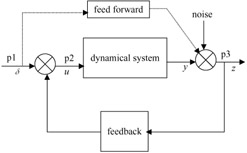
In Fig. 9.1, the block diagram of a system operating in a closed loop configuration is shown. Measurements of input (at point p1, ?), the error signal input ( u at p2) to the plant and the output ( z at p3) are generally available. Two approaches to estimate the parameters from the measured data are possible: i) Direct Identification - ignoring the presence of the feedback, a suitable identification method is applied to the data between p2 and p3; and ii) Indirect Identification - the data between p1 and p3 could be analysed to estimate equivalent parameters. In this case, the closed loop system is regarded as a composite system for parameter estimation. The knowledge of the feedback gains and the models of control blocks could then be used to retrieve the parameters of the system from the estimated equivalent model.


Figure 9.1: Closed loop system

Feedback introduces correlations between the input and output variables. Hence, when the direct identification method is used, the corresponding parameter estimates of the system could be highly correlated. In addition, the noise is correlated with input u due to feedback. As a result, it may not be possible to estimate all the system parameters independently. At best, by fixing some of the parameters at their predicted/ analytical values, a degenerate model could be estimated. In addition, due to feedback action constantly trying to generate controlled responses, the measured responses might not properly exhibit...

UNLIMITED FREE
ACCESS
TO THE WORLD'S BEST IDEAS

SUBMIT
Already a GlobalSpec user? Log in.

This is embarrasing...

An error occurred while processing the form. Please try again in a few minutes.

Customize Your GlobalSpec Experience

Category: Operational Transconductance Amplifiers (OTA)
Finish!
Privacy Policy

This is embarrasing...

An error occurred while processing the form. Please try again in a few minutes.