Modelling and Parameter Estimation of Dynamic Systems

An extended Kalman filter (Chapter 4) could be used for parameter estimation of unstable systems because of the inherent stabilisation present in the filter. As is clear from eq. (4.50), a feedback proportional to the residual error updates the state variables. This feedback numerically stabilises the filter algorithm and improves the convergence of the estimation algorithm. The following example presents the applicability of the extended UD factorisation filter for parameter estimation of an unstable second order dynamical system.
Simulate data of a second order system with the following state and measurement matrices:
| (9.7) | |
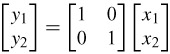
| (9.8) | |
by giving a doublet signal as input to the dynamical system (with sampling interval = 0.05 s). Use UD factorisation based EKF (EUDF) to estimate the parameters of the unstable system. Using a 22 = 0.8 (all other system parameters remaining the same), generate a second data set. Study the effect of measurement noise on the estimation results.
Simulated data for 10 s (with a sampling rate of 20 samples/s), is generated using eqs (9.7) and (9.8) (programs in folder Ch9SIMex1). The state model is formulated with the two states x 1, x 2 and the six unknown parameters in eq. (9.7) as augmented states in EUDF (Chapter 4). The measurement model uses the observations y 1 and y 2 generated using eq. (9.8). The parameter estimation programs are contained in the folder Ch9EUDFexl.
Table...