Modelling and Parameter Estimation of Dynamic Systems

Appendix B: Aircraft Models for Parameter Estimation

B.1 Aircraft Nomenclature

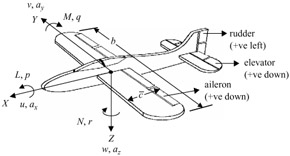
To understand aircraft dynamics and the equations of motion, it is essential to become familiar with the aircraft nomenclature. The universally accepted notations to describe the aircraft forces and moments, the translational and rotational motions and the flow angles at the aircraft are shown in Fig. B.1. The axis system is assumed fixed at the aircraft centre of gravity and moves along with it. It is called the body-axis system. The forces and moments acting on the aircraft can be resolved along the axes. The aircraft experiences inertial, gravitational, aerodynamic and propulsive forces. Of these, the aerodynamic forces X, Y and Z, and the moments L, M and N are of importance as these play the dominant role in deciding how the aircraft behaves.


Figure B.1: Body-axis system

Figure B.1 also shows the aircraft primary control surfaces along with the normally accepted sign conventions. All surface positions are angular in deflection. The aileron deflection causes the aircraft to roll about the X-axis, the rudder deflection causes the aircraft to yaw about the Z-axis and the elevator deflection causes it to pitch about the Y-axis.

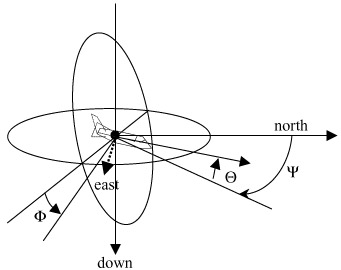
The three Euler angles describing the aircraft pitch attitude, roll angle and heading angle are illustrated in Fig. B.2 [1].


Figure B.2: Euler angles

The body-axis system notations are put together in Table B.1 below for better understanding.

Table B.1: Aircraft nomenclature

X-axis

Y-axis

Z-axis

Longitudinal axis

Lateral axis

Vertical axis

Roll axis

Pitch...

UNLIMITED FREE
ACCESS
TO THE WORLD'S BEST IDEAS

SUBMIT
Already a GlobalSpec user? Log in.

This is embarrasing...

An error occurred while processing the form. Please try again in a few minutes.

Customize Your GlobalSpec Experience

Category: Accelerometers
Finish!
Privacy Policy

This is embarrasing...

An error occurred while processing the form. Please try again in a few minutes.