Modelling and Parameter Estimation of Dynamic Systems

Research in the area of artificial neural networks has advanced at a rapid pace in recent times. The artificial neural network possesses a good ability to learn adaptively. The decision process in an artificial neural network is based on certain nonlinear operations. Such nonlinearities are useful: i) in improving the convergence speed (of the algorithm); ii) to provide more general nonlinear mapping between input-output signals; and iii) to reduce the effect of outliers in the measurements.
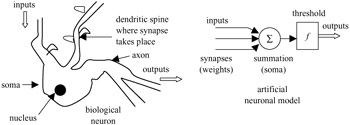
One of the most successful artificial neural networks is the so-called feed forward neural network. The feed forward neural network has found successful applications in pattern recognition, nonlinear curve fitting/mapping, flight data analysis, aircraft modelling, adaptive control and system identification [1 6]. An illustration and comparison of biological neuron and artificial neuron are given in Fig. 10.1 and Table 10.1 [7].
| Biological neuron (of human brain) | Artificial neuron |
|---|---|
| Signals received by dendrites and passed on to neuron receptive surfaces | Data enter through input layer |
| Inputs are fed to the neurons through specialised contacts called synapses | Weights provide the connection between the nodes in the input and output layers |
| All logical functions of neurons are accomplished in soma | Nonlinear activation function operates upon the summation of the product of weights and inputs f( ? W x i) |
| Output signal is delivered by the axon nerve fibre | The output layer produces the network's predicted response |
The artificial...