9.8 Total Least Squares Method and Its Generalisation
The least squares method gives biased estimates when measurement noise is present in the regressors. The total least squares approach accounts for not only errors in the measurements of output variables but also the errors in state and control variables X appearing in the regression equation [6].
In general, the regression equation is written as
| (9.97) | 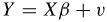
|
The least squares methods do not account explicitly for errors in X. The total least squares method addresses this problem.
Next, to arrive at a generalisation theory, in the following discussion, the state and measurement equations of the equation decoupling method are considered. The general form of these equations is given below:
| (9.98) | 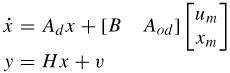
|
If H = I, the identity matrix, we have
y = x+ v
In discrete form, the above equation can be written as
| (9.99) | 
|
The above equation can also be written as
| (9.100) | 
|
| (9.101) | 
|
Here, X in its expanded form contains state, measured states and control inputs. The is the parameter vector to be estimated. Equation (9.101) has the same general form as the regression eq. (9.97) for the total least squares problem. There are measurement errors in Y of eq. (9.101), and X contains errors due to integration caused by incorrect initial conditions and round off errors. In addition, measurement errors in states x m and control inputs u m are present in general. From the above discussions it is clear that equation...


 TABLE OF CONTENTS