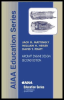
Aircraft Engine Design, Second Edition

This chapter plays a pivotal role because it provides the bridge between treating the propulsion system as a whole and beginning the design of those parts that have traditionally been identified as components and subsystems. No standard or completely comprehensive list of components and subsystems is available because they differ from company to company and engine to engine, but any reasonable collection would include at least the following components:
inlet
fan and booster
propeller and variable pitch control
low-pressure compressor (LPC)
high-pressure compressor (HPC)
main or primary burner
high-pressure turbine (HPT)
low-pressure turbine (LPT)
free or power turbine
mixer
afterburner or augmentor exhaust nozzle
and thrust reverser.
The subsystems would include the following:
nacelle
fuel delivery system
instrumentation and controls
starting and ignition system
structure
shafts, bearings, and seals
accessory gearbox and drive
propeller gearbox
lubrication and cooling systems
and fire control.
Within any engine company each of these is represented by a team of experts, many of whom have dedicated their entire careers to success. It is good to remember that, although the propulsion industry has found by experience that this breakup is most effective for management, no one component or subsystem is free from the influence of all of the others. The entire engine is coupled through aerodynamics, thermodynamics, structures, and controls; therefore, integration is a vital activity at all stages of design and development. One should also approach each component and subsystem with a minimum of prejudice about its importance to the whole. For example,...