The OpenVMS User's Guide, Second Edition
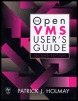
A broad introductory overview of OpenVMS that focuses on command procedures, text editing and system utilities.
 TABLE OF CONTENTS
 DECTPU programming language can be viewed as the most basic component of DECTPU. To access the features of DECTPU, you can use the EVE editor or write a program in the DECTPU language and then use the utility to compile and execute the program. A program written in DECTPU can be as simple as a single statement or as complex as the section file that implements EVE.
The block-structured DECTPU language is easy to learn and use. DECTPU language features include a large number of data types, relational operators, error interception, looping and case statements, and built-in procedures that simplify development or extension of an editor or application. Comments are indicated with a single comment character, an exclamation point (!), so that you can document your procedures easily. There also are capabilities for debugging procedures with user-written debugging programs.
DECTPU runs on the Open VMS VAX and Open VMS Alpha operating systems and supports screen-oriented editing on the VT400-, VT300-, VT200-, and VT100-series terminals, as well as on other video display terminals that respond to ANSI control functions.
This appendix discusses some of the basic components of the DECTPU language. To learn more about the DECTPU language refer to the reference material listed at the end of the appendix.
DECTPU aids application and system programmers in developing tools that manipulate text. Special features that DECTPU provides are
Multiple buffers, windows, and subprocesses
Keystroke and buffer-change journaling
Text processing in batch mode
Insert and overstrike text entry