Physical Principles of Electron Microscopy: An Introduction to TEM, SEM, and AEM

3.6: Vacuum System

3.6 Vacuum System

It is essential to remove most of the air from the inside of a TEM column, so that the accelerated electrons can follow the principles of electron optics, rather than being scattered by gas molecules. In addition, the electron gun requires a sufficiently good vacuum in order to prevent a high-voltage discharge and to avoid oxidation of the electron-emitting surface.

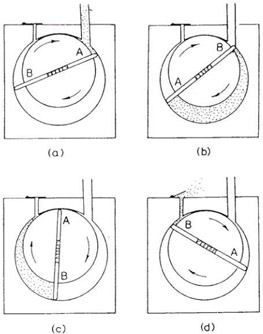
A mechanical rotary pump (RP) is used in many vacuum systems. This pump contains a rotating assembly, driven by an electric motor and equipped with internal vanes (A and B in Fig. 3-16) separated by a coil spring so that they press against the inside cylindrical wall of the pump, forming an airtight seal. The interior of the pump is lubricated with a special oil (of low vapor pressure) to reduce friction and wear of the sliding surfaces. The rotation axis is offset from the axis of the cylinder so that, as gas is drawn from the inlet tube (at A in Fig. 3-16a), it expands considerably in volume before being sealed off by the opposite vane (B in Fig. 3-16b).


Figure 3-16: Schematic diagram of a rotary vacuum pump, illustrating one complete cycle of the pumping sequence. Spring-loaded vanes A and B rotate clockwise, each drawing in gas molecules and then compressing them toward the outlet.

During the remainder of the rotation cycle, the air is compressed (Fig. 3-16c) and driven out of the outlet tube (Fig. 3-16d). Meanwhile, air in the opposite half of...

UNLIMITED FREE
ACCESS
TO THE WORLD'S BEST IDEAS

SUBMIT
Already a GlobalSpec user? Log in.

This is embarrasing...

An error occurred while processing the form. Please try again in a few minutes.

Customize Your GlobalSpec Experience

Category: Mechanical Vacuum Pumps and Systems
Finish!
Privacy Policy

This is embarrasing...

An error occurred while processing the form. Please try again in a few minutes.