Physical Principles of Electron Microscopy: An Introduction to TEM, SEM, and AEM
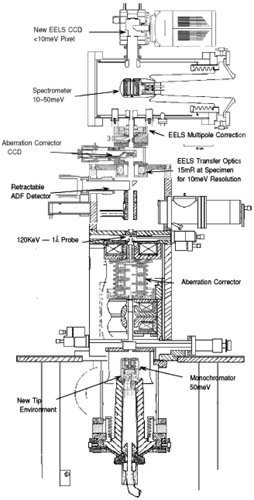
In Section 1.6, we noted that a field-emission STEM was the first instrument to successfully image single atoms in the late 1960's. Several years later, a "dedicated STEM" (operating only in scanning mode) was manufactured by the Vacuum Generators Company in the UK. A cross-sectional diagram of a substantially modified version of this instrument (at IBM Watson Research Laboratories) is shown in Fig. 7-1. Because there is no need for a viewing screen inside the lens column, its electron gun is located at the bottom of the instrument (with some advantage in terms of mechanical stability) and the electron detectors are on top (making it easier to modify the detectors or add new ones).
Most STEM images are recorded in dark-field mode, using an annular dark-field (ADF) detector located just above the specimen. Its design is similar to that of a Robinson or solid-state BSE detector used in the SEM (Fig. 5-10) but it collects electrons that are transmitted through the specimen and scattered within a certain angular range ( ? min to ? max), determined by the inner and outer diameters. By making ? min large, only large-angle (mainly elastic) scattering is collected. According to Eq. (4.15), its intensity is proportional to Z 2. Therefore...