Physical Principles of Electron Microscopy: An Introduction to TEM, SEM, and AEM
Appendix A: Mathematical Derivations

A.1 The Schottky Effect

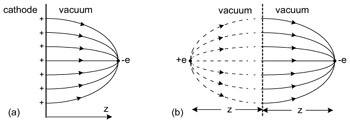
The reduction ?? in the surface-barrier height with applied electric field (Schottky effect) can be calculated by first considering the case where the extraction field is zero. When an electron leaves the conducting cathode, it generates (within the vacuum) its own electric field, which arrives perpendicular to the surface of the conductor and induces an equal and opposite charge + e that is distributed over the cathode surface (Fig. A-1a). The field lines outside the cathode are the same as those generated by an electrostatic dipole, obtained by replacing the cathode by a point charge +e located at an equal distance z inside the surface; see Fig. A-1b. The electron therefore experiences an attractive force given by Coulomb's law:

(A.1)

Figure A-1: (a) Electric field lines and surface-charge distribution produced by an electron located just outside the surface of a conductor. (b) Equivalent field lines produced by an electrostatic dipole operating in vacuum.

in which K = 1/(4 ?? 0) = 9.0 10 9 N m 2 C -2 is the Coulomb constant. The negative sign of F( z) indicates that the force acts in the -z direction, toward the surface.

With voltage applied to an extraction electrode, an additional field - E e is created (in the - z-direction) that gives rise to a force F e = - e(- E e) - + eE e

UNLIMITED FREE
ACCESS
TO THE WORLD'S BEST IDEAS

SUBMIT
Already a GlobalSpec user? Log in.

This is embarrasing...

An error occurred while processing the form. Please try again in a few minutes.

Customize Your GlobalSpec Experience

Category: Cathode Emitters and Filaments
Finish!
Privacy Policy

This is embarrasing...

An error occurred while processing the form. Please try again in a few minutes.