Physical Principles of Electron Microscopy: An Introduction to TEM, SEM, and AEM
Chapter 4: Tem Specimens and Images

Overview

In the transmitted-light microscope, variation of intensity within an image is caused by differences in the absorption of photons within different regions of the specimen. In the case of a TEM, however, essentially all of the incoming electrons are transmitted through the specimen, provided it is suitably thin. Although not absorbed, these electrons are scattered (deflected in their path) by the atoms of the specimen. To understand the formation and interpretation of TEM images, we need to examine the nature of this scattering process.

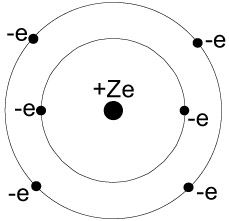
Many of the concepts involved can be understood by considering just a single "target" atom, which we represent in the simplest way as a central nucleus surrounded by orbiting particles, the atomic electrons; see Fig. 4-1. This is the classical planetary model, first established by Ernest Rutherford from analysis of the scattering of alpha particles. In fact, our analysis will largely follow that of Rutherford. Instead of positive alpha particles, we have negative incident electrons, but the cause of the scattering remains the same, namely the electrostatic (Coulomb) interaction between charged particles.


Figure 4-1: Rutherford model of an atom (in this case, carbon with an atomic number Z = 6). The electrostatic charge of the central nucleus (whose mass is M) is + Ze; the balancing negative charge is provided by Z atomic electrons, each with charge - e .

Interaction between the incoming fast electron and an atomic nucleus gives rise to

UNLIMITED FREE
ACCESS
TO THE WORLD'S BEST IDEAS

SUBMIT
Already a GlobalSpec user? Log in.

This is embarrasing...

An error occurred while processing the form. Please try again in a few minutes.

Customize Your GlobalSpec Experience

Category: Radiation Detectors
Finish!
Privacy Policy

This is embarrasing...

An error occurred while processing the form. Please try again in a few minutes.