The Circuit Designer's Companion, Second Edition
Virtually every electronic circuit built nowadays uses a printed circuit board (pcb) as both its interconnecting medium and mechanical mounting substrate. The pcb is custom-designed for the circuit it carries and its selection is an important part of the circuit designer s task, though this is frequently delegated to the (perceived) inferior function of pc layout draughtsman. The design of the pcb has a strong effect on the mechanical and electrical performance of the final product. This chapter looks at the main factors that you should consider when working with your new pcb design.
An unprocessed board is a laminate of a conductive material and an insulating dielectric substrate. The different materials that are used, and the different ways of laminating and interconnecting between conductive layers, decide the type.
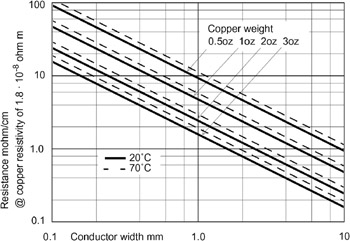
The conductive layer is almost invariably copper foil, adhesive bonded under heat and pressure to the substrate. The copper cladding thickness is usually specified (for historical reasons) by its weight per square foot, the most common being one- or twoounce, other thicknesses being 0.25, 0.5, 3 and 4-oz. Thickness of 1-oz copper is typically 0.035mm 0.002mm, other weights being thicker or thinner pro rata. The main deciding factor in choosing copper weight is its resistivity. Figure 2.3 gives resistance versus track width for the different weights.
The most common laminates are epoxy glass and phenolic paper. Phenolic paper (or synthetic resin bonded paper, s.r.b.p.) is cheaper and can...