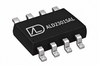
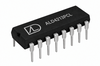
The operational amplifier is the basic building block for analogue circuits, and progress in op-amp performance is the litmus test for linear IC technology in much the same way as progress in memory devices is for digital technology. This chapter will be devoted to op-amps and comparators, with a tailpiece on voltage references. This is not to deny the enormous and ever-widening range of other analogue functions that are available, but these are intended for specific niche applications and little can be generalised about them.
Volumes have already been written about op-amp theory and circuit design and these aspects will not be repeated here. Rather, we shall take a look at the departures from the ideal op-amp parameters that are found in practical devices, and survey the tradeoffs including cost and availability, as well as technical factors that have to be made in real designs. Some instances of anomalous behaviour will also be examined.
5.1 The Ideal Op-amp
The following set of characteristics (in no particular order, since they are all unattainable) defines the ideal voltage gain block:
-
infinite input impedance, no bias current
-
zero output impedance
-
arbitrarily large input and output voltage range
-
arbitrarily small supply current and/or voltage
-
infinite operating bandwith
-
infinite open-loop gain
-
zero input offset voltage and current
-
zero noise contribution
-
absolute insensitivity to temperature, power rail and common mode input fluctuations
-
zero cost
-
off-the-shelf availability in any package
Copyright Tim Williams 2005 under license agreement with Books24x7

 TABLE OF CONTENTS