The Circuit Designer's Companion, Second Edition
In this chapter we shall concentrate on discrete semiconductor components that are in wide use throughout electronics design. Although there is a continuing trend towards gathering up discrete semiconductors into application-specific ICs (ASICs), and a parallel trend towards replacing as many analogue functions as possible by digital signal processing, discrete analogue circuits are still needed when these solutions are impossible or uneconomical. It is as well to be familiar with the characteristics of practical components as even when integrated they show the same fundamental properties.
This chapter covers the common two- and three-terminal devices: diodes, thyristors, triacs, transistors, FETs and IGBTs.
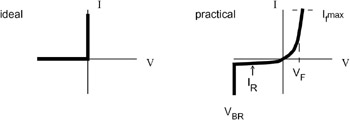
The diode is a two-terminal device whose function is to pass current in one direction but not in the other. A conventional diode is formed from the junction of p-type and ntype silicon. The ideal device has a brick-wall V-I characteristic: the practical silicon diode has an exponential characteristic which approximates to the brick wall, if viewed on a large enough scale (Figure 4.1).
The first thing to notice is that the forward voltage V F is not constant, nor is it zero. It has two determinants, forward current I F and temperature T. They are related by the equation
known as the diode equation or the Ebers-Moll equation , arguably the most fundamental mathematical expression in the whole of semiconductor electronics. The parameters q and k are the electron charge 1.6...