The Circuit Designer's Companion, Second Edition
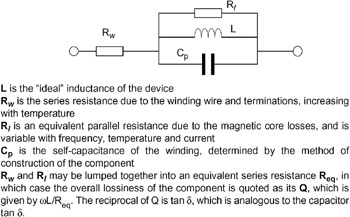
Hardly surprisingly, the inductor equivalent circuit (Figure 3.20) is very similar to the capacitor s. All practical components contain the three passive circuit elements, R, C and L, in their makeup. Both capacitors and inductors are fundamentally energy storage devices, but the practical inductor departs further from the ideal than does the practical capacitor, and so is less universally used. Also, off-the-shelf inductors are less common than capacitors, and the prospects for multiple sourcing are slight.
For this reason a tabular survey like those already given for resistors and capacitors is not really feasible. Inductors are generally made by winding wire around a magnetically permeable material and it is the performance of the material, along with the dc resistance of the wire, which determines the performance of the finished component.
Permeability is the measure of a material s ability to concentrate lines of magnetic flux. Air (and other non-magnetic materials) has a relative permeability, r, of 1. Inductors wound on a non-magnetic core are inherently low-loss, the only losses being due to the wire resistance. Unfortunately they are also inherently low inductance, which generally limits their use to the hf and vhf region. Achieving an inductance greater than 100 H without a magnetic core requires a large number of turns, so that either the component becomes unmanageably large or the wire becomes unmanageably thin. At low frequencies...