The Control Techniques Drives and Controls Handbook
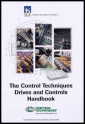
This handbook contains technical information for practicing drive and electrical engineers, covering the technology underlying drives, motors, and control units and modern practical applications.
 TABLE OF CONTENTS
 Supply harmonics are caused by the A.C. input current to load equipment departing from the ideal sinusoidal waveshape. They are produced by any nonlinear circuit, but most commonly by rectifiers.
The supply current waveform is generally measured in terms of the harmonics of the supply frequency which it contains. The harmonic current causes harmonic voltage to be experienced by other equipment connected to the same supply. Because harmonic voltage can cause disturbance or stress to other electrical equipment connected to the same supply system, it is controlled by regulations applying to public supply systems. If installations contain a high proportion of variable-speed drives and/or other power electronic equipment such as UPS, then they may have to be shown to satisfy the supply authorities' harmonic guidelines before permission to connect is granted.
As well as obeying regulations, users of drives need to ensure that the harmonic levels within their own plant are not excessive.
Some of the practical problems which may arise from excessive harmonic levels are:
poor power factor, i.e. high current for a given power
interference to equipment which is sensitive to voltage waveform
excessive heating of neutral conductors (single-phase loads only)
excessive heating of induction motors
high acoustic noise from transformers, busbars, switchgear etc.
abnormal heating of transformers and associated equipment
damage to power-factor correction capacitors
An important property of harmonics is that they tend to be cumulative on a power system, i.e. the contributions of the various harmonic sources add up to some degree. It...