The Control Techniques Drives and Controls Handbook
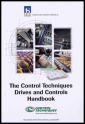
This handbook contains technical information for practicing drive and electrical engineers, covering the technology underlying drives, motors, and control units and modern practical applications.
 TABLE OF CONTENTS
 The purpose of this Chapter is to set out the necessary considerations for system designers and others when incorporating electronic variable-speed drives into complete machines and systems without encountering problems with electromagnetic interference, and in compliance with relevant regulations. Of necessity, only general guidelines have been provided, but since real installations have a wide variety of detailed requirements, explanation of the underlying principles is given to allow the designer to cope with specific situations.
All electrical equipment generates some degree of electromagnetic emission as a side effect of its operation. It also has the potential to be affected by incident electromagnetic energy. Equipment using radiocommunication contains intentional emitters and sensitive receivers.
The basic principle of EMC is that electromagnetic emission of electrical equipment, whether intentional or unintentional, must not exceed the immunity of associated equipment. This means that controls must be in place on both emission and immunity. Given the variety and uncertainty of effects and situations, some margin of safety must be provided between these two factors.
Although all equipment exhibits some degree of emission and susceptibility, the limiting factors in most common environments tend to be related to radio equipment, with its powerful transmitters and sensitive receivers. Therefore, the majority of EMC standards are related to the requirements of radiocommunications systems.
In principle, EMC covers phenomena over an unlimited range of frequencies and wavelengths. The EU EMC directive limits itself to a range of 0 to 400 GHz. This range is so...