The Control Techniques Drives and Controls Handbook
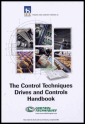
This handbook contains technical information for practicing drive and electrical engineers, covering the technology underlying drives, motors, and control units and modern practical applications.
 TABLE OF CONTENTS
 The successful integration of electronic variable-speed drives into a system depends upon knowledge of a number of key characteristics of the application and the site where the system will be used. This chapter contains basic considerations, which can help a user or system designer to avoid some of the most common problems. First, advice is given on selecting the most appropriate drive type. Then guidance is provided on basic requirements of the installation to help ensure trouble-free operation.
A design matrix for electronic variable-speed drives is given in Table 11.1
| D.C. drives (separately-excited motor) | A.C. drives | |||||
|---|---|---|---|---|---|---|
| Phase controlled | Chopper | Open-loop induction motor (V/f) | Open-loop induction motor (vector) | Closed-loop induction motor (flux vector) | Brushless servodrive PM motor | |
| Operating speed range | 0 to base speed at constant torque above base speed at constant power maximum approximately four base speed | 10 100% base speed at constant torque, above base speed at constant power maximum approximately 20 base | 3 100% base speed at constant torque, above base speed at constant power maximum approximately 20 base | 0 100% base speed at constant torque, above base speed at constant power maximum approximately 20 base | 0 100% base speed at constant torque, no operation above base speed | |
| Braking capability | 150% (4Q drive) | 150% (4Q drive) | 150% | 150% | 150% | >200% |
| Speed loop response | 10 Hz | 50 Hz | 5 Hz | 10 Hz | 100 Hz | >100 Hz |
| Speed holding (100% load change) | 0.1% ?tacho f/b... |