Engineering Surveying, Sixth Edition
With many worked examples and illustrations of tools and techniques, this important text gives readers a clear understanding of fundamentals such as vertical control, distance, angles and position.
 TABLE OF CONTENTS
 As shown in Chapter 1, horizontal and vertical angles are fundamental measurements in surveying.
The vertical angle, as already illustrated, is used in obtaining the elevation of points (trig levelling) and in the reduction of slant distance to the horizontal.
The horizontal angle is used primarily to obtain direction to a survey control point, or to topographic detail points, or to points to be set out.
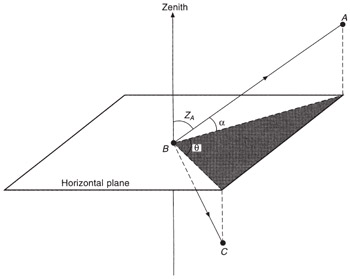
An instrument used for the measurement of angles is called a theodolite, the horizontal and vertical circles of which can be likened to circular protractors set in horizontal and vertical planes. It follows that, although the points observed are at different elevations, it is always the horizontal angle and not the space angle which is measured. For example, observations to points A and C from B (Figure 5.1) will give the horizontal angle ABC = ?. The vertical angle of elevation to A is ? and its zenith angle is Z A.
There are basically two types of theodolite, the optical mechanical type or the electronic digital type, both of which may be capable of reading directly to 1', 20", 1 " or 0.1" of arc, depending upon the precision of the instrument. The selection of an instrument specific to the survey tolerances of the work in hand is usually overridden by the commercial considerations of the company and a 1" instrument may be...