Engineering Surveying, Sixth Edition
With many worked examples and illustrations of tools and techniques, this important text gives readers a clear understanding of fundamentals such as vertical control, distance, angles and position.
 TABLE OF CONTENTS
 The transition curve is a curve of constantly changing radius. If used to connect a straight to a curve of radius R, then the commencing radius of the transition will be the same as the straight ( ?), and the final radius will be that of the curve R (see Figure 10.28).
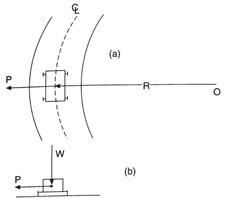
Consider a vehicle travelling at speed ( V) along a straight. The forces acting on the vehicle will be its weight W, acting vertically down, and an equal and opposite force acting vertically up through the wheels. When the vehicle enters the curve of radius R at tangent point T 1, an additional centrifugal force ( P) acts on the vehicle, as shown in Figures 10.24 and 10.25. If P is large the vehicle will be forced to the outside of the curve and may skid or overturn. In Figure 10.25 the resultant of the two forces is shown as N, and if the road is super-elevated normal to this force, there will be no tendency for the vehicle to skid. It should be noted that as
| (10.9) |  |
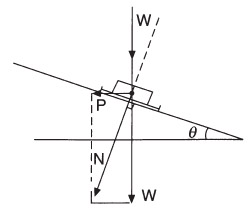
super-elevation will be maximum at minimum radius R.
It therefore requires a length of spiral curve to permit the gradual introduction of super-elevation, from zero at the start of the transition to maximum at the end, where the radius is the minimum safe radius R.