Lee's Loss Prevention in the Process Industries,: Hazard Identification, Assessment and Control, Volume 1, Third Edition

15.3: Two-Phase Flow: Fauske Models

15.3 Two-Phase Flow: Fauske Models

15.3.1 Fauske empirical model

An early empirical model for two-phase flow was that described by Fauske (1964). The model is relatively simple and readily adaptable, and has been widely used. The general form of the model is


where C d is the coefficient of discharge, G is the mass velocity, P o is the absolute stagnation pressure, P * is the effective downstream pressure and ? l is the density of the liquid.

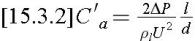
A correlation for the transition from single-phase to two-phase flow in fluid flowing from a vessel through an aperture or short pipe to atmosphere has been given by Min, Fauske and Petrick (1966). The transition is correlated in terms of a modified cavitation number :


where d is the diameter of the pipe, l is the length of the pipe, ? P is the pressure difference, U is the average velocity of fluid and ? l is the density of the saturated or subcooled fluid in the vessel. Flow is single-phase for values of less than 9 and two-phase for values greater than 15. At values between 9 and 15, unstable transitional flow occurs.

The empirical model given by Fauske (1964) is based on experimental work on the flow of a saturated liquid from a vessel through an aperture or an aperture connected to a short pipe to atmosphere. For a system in which the aperture was a sharp edged orifice,...

UNLIMITED FREE
ACCESS
TO THE WORLD'S BEST IDEAS

SUBMIT
Already a GlobalSpec user? Log in.

This is embarrasing...

An error occurred while processing the form. Please try again in a few minutes.

Customize Your GlobalSpec Experience

Category: Flow Switches
Finish!
Privacy Policy

This is embarrasing...

An error occurred while processing the form. Please try again in a few minutes.