Lee's Loss Prevention in the Process Industries,: Hazard Identification, Assessment and Control, Volume 1, Third Edition
In certain circumstances a vessel may rupture completely. If vessel rupture occurs, a large vapour cloud can be formed very rapidly. Accounts of vessel rupture include those by Hardee and Lee (1974, 1975), Hess, Hoffmann and Stoeckel (1974), J.D. Reed (1974), Maurer et al. (1977), AF. Roberts (1981/82) and B. Fletcher (1982).
If a vessel containing a superheated liquid under pressure ruptures, a proportion of the liquid vaporizes. This initial flash fraction is determined by the heat balance, the latent heat of vaporization being supplied by the fall in the sensible heat of the liquid. The rapid formation of vapour bubbles also generates a spray of liquid drops so that typically most or all of the remaining liquid becomes airborne, leaving little or no residue in the vessel.
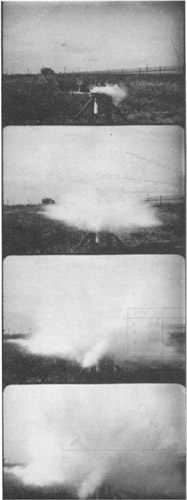
This effect has been demonstrated by J.D. Reed (1974), who carried out experiments on sudden vessel depressurization. In one series of experiments, 3.5 kg of liquid ammonia contained at an absolute pressure of 3 bar and a temperature of 9 C in a vessel 15 cm diameter and 45 cm high was released using a quick release lid. One of the experiments is shown in Figure 15.19, in which the time interval between the first and last frame is one-sixth of a second. In all the experiments at least 90% of the liquid ammonia was vaporized.