Mechanics of Offshore Pipelines: Buckling and Collapse, Vol. I

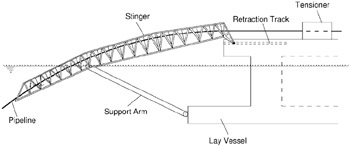
Bending in the presence of tension is experienced by pipelines mainly during their installation, and in some special cases during their operation. For example, in the S-lay installation method the pipe is bent over the stinger while it is simultaneously subjected to significant tension (Figure 10.1). In conventional applications, the pipe is installed empty, reducing the required tension, while the angle at which the line leaves the stinger ( departure angle) is relatively small. Under these conditions the pipe remains elastic, which is desirable for the stability of the line once it reaches the sea floor. In a few deep-water applications, pipelines have been installed flooded, increasing the required tension. In addition, in order to reduce the horizontal component of the force required from the lay vessel, the pipe departure angle is much larger and the stinger much longer, as shown in Figure 2.18 [10.1]. The combined effect of the relatively high tension and stinger curvature can plastically deform the line while on the stinger [10.2]. Once off the stinger, the line is under combined bending and tension, which is required in order to control its configuration, in particular the curvature of the sagbend.
In the reeling installation method shown in Figure 2.4, some tension is applied as the pipe is wound onto the reel (see Section 2.2.3). During unreeling, most of the tension is applied by the tensioner mounted on the ramp; in other words, after the pipe is straightened. In...