Mechanics of Offshore Pipelines: Buckling and Collapse, Vol. I
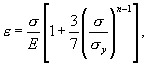
Structural metal stress-strain responses can often be represented through a power-law relationship. One of the most commonly used relationships is the three-parameter Ramberg-Osgood expression
| (C.1) | |
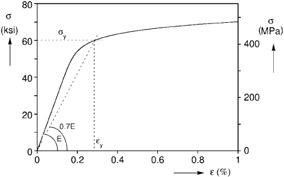
where E, ? y and n are fit parameters. These can be determined from a measured stress-strain response as follows:
E is the slope of the linearly elastic part of the response.
? y is the stress at the intersection of the stress-strain response and a line through the origin with a slope of 0.7 E (see Figure C.1).
An approximate value of n is obtained from the slope of the linear part of the plot of log
vs.log ( ?).
Plot this first estimate of the fit and compare it directly with the experimental response. Adjust ? y and n (usually slightly) iteratively until the best fit is achieved.
It is not always possible to obtain a close fit for small values of strain, say on the order of 0.5%, and for larger values simultaneously. Therefore, it is best to restrict the fit to the part of the response relevant to the problem at hand. If the strain range of interest is large, the response can be fitted with (C.1) up to some strain level and with another fit (a straight line often works) for larger values.
Several parametric studies conducted in this book involve the three X52 line grade steel stress-strain responses shown...