Mechanics of Offshore Pipelines: Buckling and Collapse, Vol. I

Several viable nonlinear shell theories are available for circular cylindrical shells. Versions of these theories that correspond to the same level of approximation differ from each other in small ways that do not usually affect the solution. In this book we have adopted mainly Sanders' [D.1] shell equations with the assumptions that mid-surface strains are small and rotations are "small but finite." The strain-displacement and equilibrium equations are presented here.
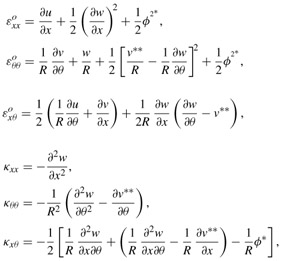
Consider a circular cylindrical shell of radius R and wall thickness t. Define a cylindrical coordinate system { x, ?, r} and let { u, v, w} be the corresponding displacements. The membrane and bending components of the strains in terms of the displacements are
| (D.1) | |
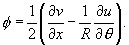
where
The total strains are given by
| (D.2) | |
where z is the through-thickn coordinate.
The force and moment intensities are given by
| (D.3) | |
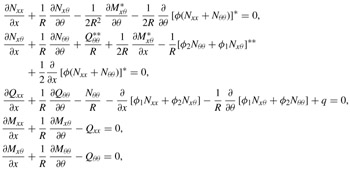
The equilibrium equations in terms of the force and moment intensities are
| (D.4) | |
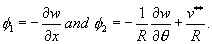
where
Two additional levels of simplification can be made when the problem allows it:
Rotations about the normal to the shell are neglected by dropping terms with ( ?)*.
The shallow-shell equations, also known as the Donnell-Mushtari-Vlasov equations (DMV), are arrived at by eliminating terms with ( ?)* and ( ?)**. In this case, characteristic deformation wavelengths must be small compared to the minimum principal radius of curvature.
D.1. Sanders Jr., J.L. ( 1963). Nonlinear theories for thin shells. Quart.