Mechanics of Offshore Pipelines: Buckling and Collapse, Vol. I

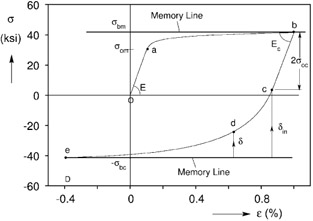
This model is another candidate to be used for loading histories involving loading and reverse loading. The model is calibrated using uniaxial stress-strain data as described next. The monotonic part of the response (o-a-b) is fitted with the Ramberg-Osgood fit as described in Appendix C. For the results in Figure F.1, o-a-b had the following Ramberg-Osgood parameters:
| (a) | |
where ? om is the proportional limit stress.
The material parameters for the basic hysteresis curve (b-c-d-e), E c, ? oc and h are obtained as follows:
E c is the elastic modulus of the hysteresis curve; i.e., it is the slope of section b-c of the unloading curve. Usually, but not always, E c = E m.
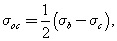
? oc is the radius of the yield surface, calculated as follows. Identify the elastic limit of the hysteresis curve (point c). Then
| (F.1) | |
where ? b and ? c are the stresses corresponding to points b and c on the response.
h is a shape parameter representing the hardening characteristics of the hysteresis curve. It can be evaluated as follows:
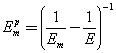
Find the slope, E m, of the monotonic curve at point b. The corresponding plastic modulus at point b is
| (F.2) | |
The stress at point b, ? b, represents the current size of the memory surface.
Construct the memory line by drawing a...