Mechanics of Offshore Pipelines: Buckling and Collapse, Vol. I

Appendix E: Stress-Strain Fitting for the Dafalias-Popov Model

OVERVIEW

This model is usually used for loading histories involving loading and reverse loading. For this reason, the initial monotonic stress-strain response and the subsequent stable hysteresis are fitted separately. First convert the two responses into stress-plastic strain responses by using

(E.1)

Now follow the fitting steps below.

A. FIT OF MONOTONIC STRESS-STRAIN RESPONSE

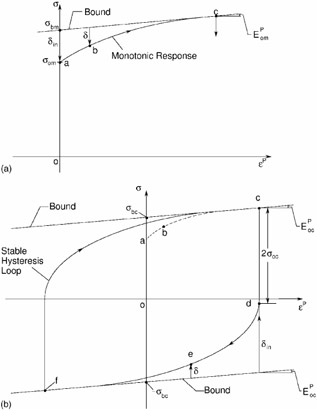
The monotonic part of the response (o-a-b-c in Figure E.1 (a)) is fitted as follows:

  1. E m is Young's modulus of o-a.

  2. ? om is the elastic limit of o-a-b-c.

  3. The bounding line is constructed by drawing the tangent to a-b-c at the maximum value of strain available.

  4. is the slope of the bound.

  5. ? bm is the stress value at the point of intersection of the bound and the stress axis ( ? P = 0). ? bm will be the radius of the bounding surface during monotonic loading.

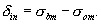
  6. Calculate the variable ? in as follows

    (E.2)
  7. Select a point along a-b-c (point b in Figure E.1(a)) and measure the stress difference ?. between it and its image on the bound. Point b is chosen such that

    (E.3)
  8. Evaluate the plastic strain at point b,

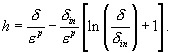
  9. h is evaluated by substituting the values of ? and ? P at point b into (E.4)

    (E.4)

Figure E.1: Stress-plastic strain responses with definitions of Dafalias-Popov model parameters (a) monotonic response and (b) Fit of Stable Hysteresis Response.

B. STABLE HYSTERESIS STRESS-STRAIN RESPONSE

The stable hysteresis loop c-d-e-f in...

UNLIMITED FREE
ACCESS
TO THE WORLD'S BEST IDEAS

SUBMIT
Already a GlobalSpec user? Log in.

This is embarrasing...

An error occurred while processing the form. Please try again in a few minutes.

Customize Your GlobalSpec Experience

Category: Pressure Sensors
Finish!
Privacy Policy

This is embarrasing...

An error occurred while processing the form. Please try again in a few minutes.