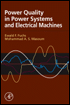
Power Quality in Power Systems and Electrical Machines
Capacitors are extensively used in power systems for voltage control, power-factor correction, filtering, and reactive power compensation. With the proliferation of nonlinear loads and the propagation of harmonics, the possibility of parallel/series resonances between system and capacitors at harmonic frequencies has become a concern for many power system engineers.
Since the 1990s, there has been an increase of nonlinear loads, devices, and control equipment in electric power systems, including electronic loads fed by residential and commercial feeders, adjustable-speed drives and arc furnaces in industrial networks, as well as the newly developing distributed generation (DG) sources in transmission and distribution systems. This has led to a growing presence of harmonic disturbances and has deteriorated the quality of electric power. Moreover, some nonlinear loads and power electronic control equipment tend to operate at relatively low power factors, causing poor voltage regulation, increasing line losses, and forcing power plants to supply more apparent power. The conventional and practical procedure for overcoming these problems, as well as compensating reactive power, are to install (fixed and/or switching) shunt capacitor banks on either the customer or the utility side of a power system. Capacitor banks are also used in power systems as reactive power compensators and tuned filters. Recent applications are power system stabilizers (PSS), flexible AC transmission systems (FACTS), and custom power devices, as well as high-voltage DC (HVDC) systems.
Misapplications of power capacitors in today s modern and complicated industrial distribution systems could have negative impacts on both the customers (sensitive linear and nonlinear...