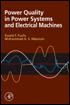
Power Quality in Power Systems and Electrical Machines
One of the main responsibilities of a utility system is to supply electric power in the form of sinusoidal voltages and currents with appropriate magnitudes and frequency for the customers at the points of common coupling (PCC). Design and analysis of system equipment and user apparatus are based on sinusoidal current and voltage waveforms with nominal or rated magnitudes and frequency. Although the generated voltages of synchronous machines in power plants are nearly sinusoidal, some undesired and/or unpredictable conditions such as lightning and short-circuit faults and nonlinear loads cause steady-state and/or transient voltage and current disturbances. For example, electric arc furnaces cause voltage fluctuations, power electronic converters generate current harmonics and distort voltage waveforms, and short-circuit faults result in voltage sags and swells. On the other hand, most customer loads such as computers, microcontrollers, programmable logic controllers (PLCs), and hospital equipment are sensitive and unprotected to power quality disturbances and their proper operation depends on the quality of the voltage that is delivered to them.
To optimize the performance and stability of power systems and to overcome power quality problems, many techniques and devices have been proposed and implemented. Conventional devices used for voltage regulation, power factor correction, and power quality improvement include shunt or series power capacitors, phase shifters, and passive or active filters (Chapter 9). Advanced technical solutions are flexible AC transmission system (FACTS) devices [1, 2] to improve voltage regulation, as well as steady-state and instantaneous active and reactive power control at fundamental frequency.