The Quantum Leap: Next Generation
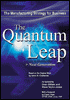
Documenting the forces shaping today's demand-driven markets, this comprehensive desk reference provides a proven mathematically based roadmap for implementing Demand Flow Technology (DFT).
 TABLE OF CONTENTS
 The world-class manufacturer focuses on creating a high-quality and extremely efficient flow process that responds to customer demand. In the past, the traditional manufacturer didn't focus on the production process, despite its importance in determining the quality of the final product. With this in mind, manufacturers should recognize the strategic importance of the production process.
As a company evolves toward world-class flow manufacturing, the nature of the production process, along with key performance measures, will change significantly. Traditional terms such as scheduling, queue, labor tracking, subassemblies, production routing, and others become less relevant, if not altogether unnecessary.
A new vocabulary has emerged to describe flow manufacturing, and many companies are now using these new terms. The flow manufacturer employs terms such as TQC, sequence of events, team pass, kanban, total product cycle time, RIP, linearity to plan, flexible forecasts, cycle-time costing, operational cycle time, takt time (the German word for "rhythm" or "beat"), and many others.
DFT builds on a production flow process that uses a range of kanban tools to pull material into and through the production process as material is consumed. The rate-based production flow pulls material from a nearby point of supply. This flexible pull environment views a product as a "pile of parts" that flows through a sequence of events, ultimately resulting in the final product. The underlying objective of DFT is to produce the highest-quality product in a customer-responsive flow process.
Demand Flow manufacturing is a...