The Quantum Leap: Next Generation

Documenting the forces shaping today's demand-driven markets, this comprehensive desk reference provides a proven mathematically based roadmap for implementing Demand Flow Technology (DFT).
 TABLE OF CONTENTS
 The technology and methodology of Demand Flow manufacturing change the role of the computer system. Many of the execution techniques of Demand Flow manufacturing don't require a supporting system. However, information-technology support can make it easier to do the following:
Calculate operational cycle time
Calculate total product cycle time (TP c/t)
Establish a demand-based daily-rate production plan
Manage kanban tools
Administer demand-based forecasting of material from suppliers
Calculate the application of overhead to TP c/t
Calculate the resources (key machine utilization and the number of people) required to meet the daily rate
Improve process efficiency for management reporting
Assess production linearity for management reporting
Compare actual versus planned production-employee efficiency
Manage TQC operational sheets
Maintain efficient supplier management
Demand Flow manufacturing requires substantially fewer system transactions, decreasing the company's reliance on information technology to manage transactions. However, Demand Flow manufacturing without a computer may in fact be easier than MRP II with a computer (see Figure 14.1).
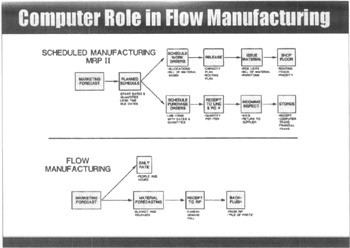
Toyota and many other major flow-manufacturing companies do not use computers for the planning and execution of their flow-manufacturing processes. However, system support can assist in line design, daily management and planning, and in the forecasting and control of material movement to and from suppliers.
Material planning initially meant exploding a bill of material solely for calculating the purchased material needed for a product. As the traditional computer system evolved into MRP I, and as the bill of material evolved into...