The Quantum Leap: Next Generation
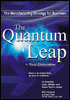
Documenting the forces shaping today's demand-driven markets, this comprehensive desk reference provides a proven mathematically based roadmap for implementing Demand Flow Technology (DFT).
 TABLE OF CONTENTS
 Just as the internal DFT implementation begins with defining the TQC sequence of events, defining operation-cycle times and points of kanban, and documenting the process, so does the process of educating suppliers. Suppliers must gain a basic understanding of flow strategies and technology. Suppliers must also understand that, although the company is not operating under Demand Flow manufacturing today, it is moving swiftly toward becoming a Demand Flow manufacturer.
One of the most misunderstood and misused aspects of DFT is supplier management. Many suppliers are extremely cautious about flow (JIT) manufacturing because they have the erroneous impression that flow manufacturing requires suppliers to store buyers' inventory. Suppliers see that they must make frequent, sometimes daily, deliveries, and produce 100 percent defect-free materials while reducing costs.
Demand Flow manufacturing extends the in-process quality and material-pull techniques back to the source for higher-quality and lower-cost materials. The supplier becomes an extension of the manufacturing process in a relationship that tends to be more mutually advantageous. Many of the guidelines for the relationship between the Demand Flow manufacturer and supplier are predicated on common goals, mutual trust, and mutual advantage.